Borromini staircase: read the palace before the paintings
Open with the answer
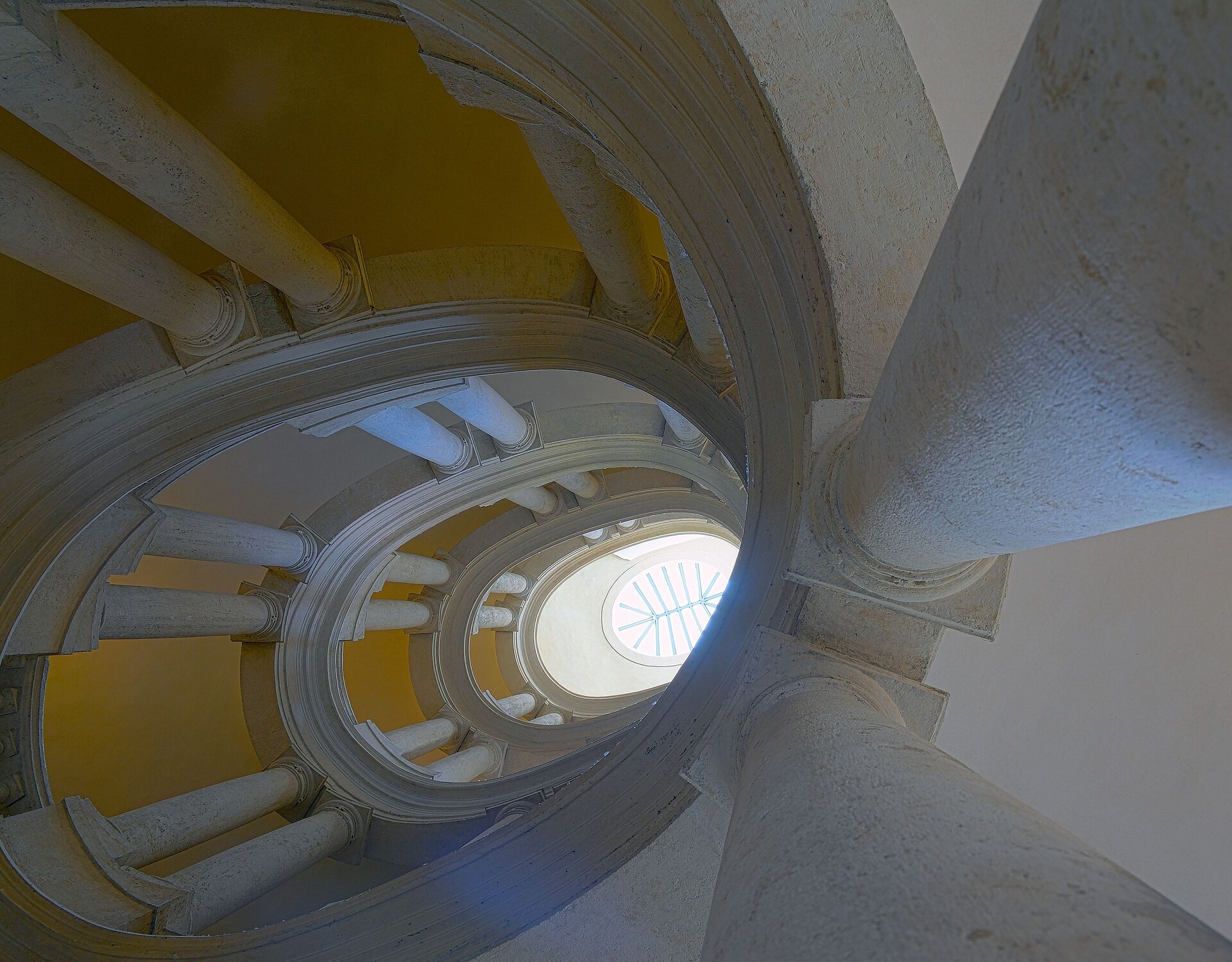
<!-- attraction:answer --> The BorrominiFrancesco BorrominiFrancesco Borromini (1599 to 1667) was Bernini's rival and the most inventive architect of the Roman Baroque. At Palazzo Barberini the oval helicoidal staircase is attributed to him. staircase at Palazzo Barberini and its BerniniGian Lorenzo BerniniGian Lorenzo Bernini (1598 to 1680) was the sculptor and architect who shaped Baroque Rome: the Borghese sculpture groups, the colonnade of St Peter's Square and the fountains of Piazza Navona. counterpart deserve the first twenty minutes of your ticket time. These two staircases, facing each other across the entrance hall, turn architecture into a legible contest and prepare you to read the palace as a collaboration between rival designers rather than as a container for paintings.
Is it worth dedicating time to the staircases?
<!-- attraction:worth --> Spending time on the two staircases before heading to the CaravaggioCaravaggioCaravaggio, born Michelangelo Merisi in Milan in 1571 and dead at Porto Ercole in 1610, is the painter of dramatic light whose Roman years left works in the Borghese, the Doria Pamphilj, Palazzo Barberini and three ch... and RaphaelRaphaelRaphael (1483 to 1520) painted the four Raphael Rooms in the Vatican for Julius II and his successors and is buried in the Pantheon. His Transfiguration hangs in the Vatican Pinacoteca. rooms reframes the visit. Most visitors treat Palazzo Barberini as a picture galleryPinacotecaA pinacoteca is a painting gallery, as opposed to a collection of sculpture or antiquities. The Vatican Pinacoteca and the Capitoline Pinacoteca are separate wings within their museums. and rush upstairs to Giuditta e Oloferne and La Fornarina, missing the fact that the building itself is a signed work by three architects who rarely shared a project. The case for starting with the staircases is that the palace then reads as a designed object instead of as wallpaper behind frames. Bernini's square-shafted staircase is grand and symmetrical. Borromini's oval helicoidal staircase, probably his design according to the Barberini Corsini Galleries, is geometrically tighter and rises in a spiral around paired columns that carry the visitor up without a central newel. The case against is that twenty minutes here reduces time on the second floor where the paintings concentrate. If you came only for Caravaggio and have no interest in seventeenth-century spatial games, the staircases add nothing to that goal. But if you want to understand why Palazzo Barberini is considered the prototypical BaroqueBaroqueThe Baroque is the art of seventeenth-century Rome: theatrical, emotional and built for the Counter-Reformation papacy. Bernini, Borromini and Caravaggio are its Roman names. palace, the staircases deliver that proof faster than any label.
What you actually see and do
<!-- attraction:experience --> You enter Palazzo Barberini today from via delle Quattro Fontane through the portico façade. Immediately inside, two staircases appear on opposite sides of the ground floor, both leading up to the monumental entrance hall one level above. Bernini's staircase is on one side, designed with a square shaft and a formal, columned progression. Walk it first to reach the hall. Once there, Pietro da Cortona's frescoes cover the ceiling, and you can see across to the other side where Borromini's staircase begins its ascent. That contrast is the point. Borromini's staircase is oval in plan and helicoidal in section. It winds upward on paired columns, tighter and more compressed than Bernini's ceremonial version. Walk down it once to see how the spiral works from below, then climb back up to continue to the collection floors. The entrance hall itself, with its frescoed vault, is the shared goal of both routes and closes the architectural introduction. After this, the palace floor plan, that innovative H-shape designed by Carlo Maderno incorporating the earlier Sforza villa, starts to make sense as you move through the galleries.
How much time the staircases require and when to visit them
<!-- attraction:timing --> Allow twenty minutes to walk both staircases, pause in the entrance hall and register the difference between the two designs. That estimate assumes you want to descend the Borromini helix once for the full spatial effect and are reading the architecture rather than photographing it. If you skip the comparison and simply take whichever staircase is closest to reach the upper floors, five minutes covers the climb. The staircases are part of the included route with general admission and are not separately ticketed or timed. Because they sit at the start of the visit, they are least crowded immediately after opening, but the halls are wide enough that congestion is rare outside of group tour surges. Do the architecture first, before decision fatigue sets in on the painting floors. Once you have spent an hour looking at portraits and altarpieces, the appetite for formal analysis drops and the staircases become simply the way out.
How to get there
<!-- attraction:access --> Palazzo Barberini sits on via delle Quattro Fontane in central Rome, close to Piazza Barberini. Metro line A stops at Barberini, one station from Termini and Repubblica, placing the palace within a short walk from the station exit. The neighbourhood is dense and walkable, and many visitors combine Palazzo Barberini with other Quirinal Hill sites or approach it on foot from Trevi or the Spanish Steps, both under one kilometre away. Buses serve the area, but the Metro connection is faster and more direct for most routes. If you are staying near Termini or anywhere along line A, the journey is straightforward. No advance transport reservation is required. The entrance is on via delle Quattro Fontane, not on Piazza Barberini itself, so approach from the street rather than the square. On foot from Trevi, walk east and slightly uphill. The palace façade is set back from the street behind a small forecourt, and the current entry point is through the portico that Gian Lorenzo Bernini likely designed in 1629 when he took over construction after Carlo Maderno.
What to know before you go
<!-- attraction:practical --> Bring nothing large. Standard museum security applies, and bags over a certain size trigger a deposit requirement, though the Barberini Corsini site does not specify the exact limit in the supplied material, so check their visit page for current bag policy. Photography rules are not detailed in the source, so confirm restrictions when you enter. Wear comfortable shoes. Both staircases involve full-height climbs, and the Borromini helix has no lift alternative for that specific route, though the palace itself has accessibility provisions described on the official site. The most common mistake is ignoring the staircases altogether and heading straight to the second-floor gallery, which cuts the architecture from the visit and turns the palace into an undifferentiated container. Another error is attempting to see every painting in the collection if your real interest is the building. The galleries span multiple floors and centuries, and completionism here leads to fatigue. Decide in advance whether you came for Baroque architecture or for Caravaggio, and defend that choice once other visitors and directional signs try to reroute you.
Who should prioritise the staircases
<!-- attraction:fit --> First-time visitors to Palazzo Barberini should start with the staircases because the architecture context prevents the Caravaggio rooms from floating in generic museum space. Families with children old enough to notice geometry will find the Borromini spiral easier to explain than most paintings, though toddlers gain nothing from the comparison. Couples interested in design history and Baroque Rome get more from twenty minutes on the staircases than from another Raphael Madonna if they have already seen several. Repeat visitors who skipped the architecture on an earlier trip should correct that now, because the staircases change faster than the collection and recent conservation makes details visible that were obscured before. Rain-day visitors lose nothing by dedicating time indoors to spatial problems, and the staircases are fully covered. If you have no interest in architecture and came only to see specific paintings, take whichever staircase is nearer and move on. The route works either way, but the editorial recommendation for most visitors is to read the palace before the paintings.
Official sources
- https://barberinicorsini.org/en/palazzo-barberini/
- https://barberinicorsini.org/en/collections/
Best tours and tickets
Curated selection. We may earn a commission if you book, at no extra cost to you.

Private Tour - Palazzo Barberini

Rome: Colosseum, Roman Forum and Palatine Hill Guided Tour
Frequently asked questions
Which staircase at Palazzo Barberini is better, Bernini's or Borromini's?
How long does it take to see both staircases at Palazzo Barberini?
Can I visit the Borromini staircase without a Palazzo Barberini ticket?
Should I see the staircases before or after the paintings at Palazzo Barberini?
Is the Borromini staircase accessible by lift?
What is special about the Borromini staircase at Palazzo Barberini?
Related guides
Rome Museums in Late 2026: What Actually Changes for Bookings and Timed Entry
What late 2026 changes mean for Rome museum bookings, timed slots and archaeological site visits, with official pages to confirm before you travel.
Read more →Rome Museums in 2026: New Rules, Closures and What to Book Before You Go
What changed at Rome's museums, archaeological sites and Vatican collections in 2026, plus what to reserve and which official pages to check.
Read more →Rome Museum News: Vatican Museums, Colosseum and New Heritage Rules for Autumn 2026
New heritage rules, exhibitions and ticketing changes in Rome museums. What travelers need to book now for autumn 2026.
Read more →Raphael's Lady with a Unicorn Leaves the Borghese Gallery for Vimercate
Raphael's Lady with a Unicorn leaves the Borghese Gallery for a free show at MUST Vimercate, 29 October to 11 December 2026. Plan the Rome side.
Read more →Rome Museums: What October 2026 Travelers Actually Need to Check Before Booking
Independent guide to Rome museums and heritage. Verify tickets, reservations and closures on official sites before your October 2026 trip.
Read more →Rome Museums in October: What Changes for Visitors, From Closures to New Access Rules
October shifts behind the scenes at Rome's museums and sites. Check official pages for closures, timed entry and reservation rules before you book.
Read more →All prices and times on this page are ESTIMATES and change often. They are a starting point from an independent editor, never official or guaranteed figures. Always check the final price and the opening hours with the official venue or operator before you book or travel.