Ostia Antica theatre: train and walk, or a guided half day
Open with the answer
<!-- attraction:answer --> The Ostia AnticaParco archeologico di Ostia anticaThe Parco archeologico di Ostia antica is the state site covering the ancient port city of Rome at the mouth of the Tiber, plus the harbours of Claudius and Trajan and the Portus necropolis. theatre stands in one of the largest Roman archaeological parksArea archeologicaAn area archeologica is an open-air archaeological site managed like a museum, with tickets, opening hours and routes. In Rome the label covers the Forum, the Palatine, Ostia Antica and the Baths of Caracalla., covering roughly 70 hectares with scattered monuments. An independent train trip from Rome gives you price control and unlimited time but requires navigating the sprawling site on foot with patchy signage. A guided half-day tour solves orientation and context but commits you to a fixed route and group pace across a site where shade and rest matter.
Is the Ostia Antica theatre worth it?
<!-- attraction:worth --> Yes, if you accept that the theatre is one stop in a multi-hour walk through a preserved Roman port city, not a standalone visit. The theatre itself is a semicircular stone structure with visible seating tiers and a partial stage wall, less complete than the Theatre of Marcellus in central Rome but set in open parkland rather than trapped between modern buildings. What makes it worth the journey is the surrounding context: warehouses, apartment blocks, taverns and mosaics that show daily life rather than imperial propaganda. Skip Ostia Antica entirely if you want a single monument with minimal walking. The park demands stamina, decent footwear and at least three hours. It beats the Forum in Rome for spatial clarity because the street grid is legible and you can enter most buildings. It loses to Pompeii for drama and to Herculaneum for preservation, but it beats both on proximity to Rome. First-time visitors chasing a short list should prioritize the Colosseum and Borghese GalleryGalleria BorgheseThe Galleria Borghese is the state museum in the Borghese villa holding Bernini's sculptures and the Caravaggio paintings collected by Cardinal Scipione Borghese. Entry is by reserved two-hour slot only. before spending half a day here. Repeat visitors with an extra morning gain more.
What you actually see and do at the theatre
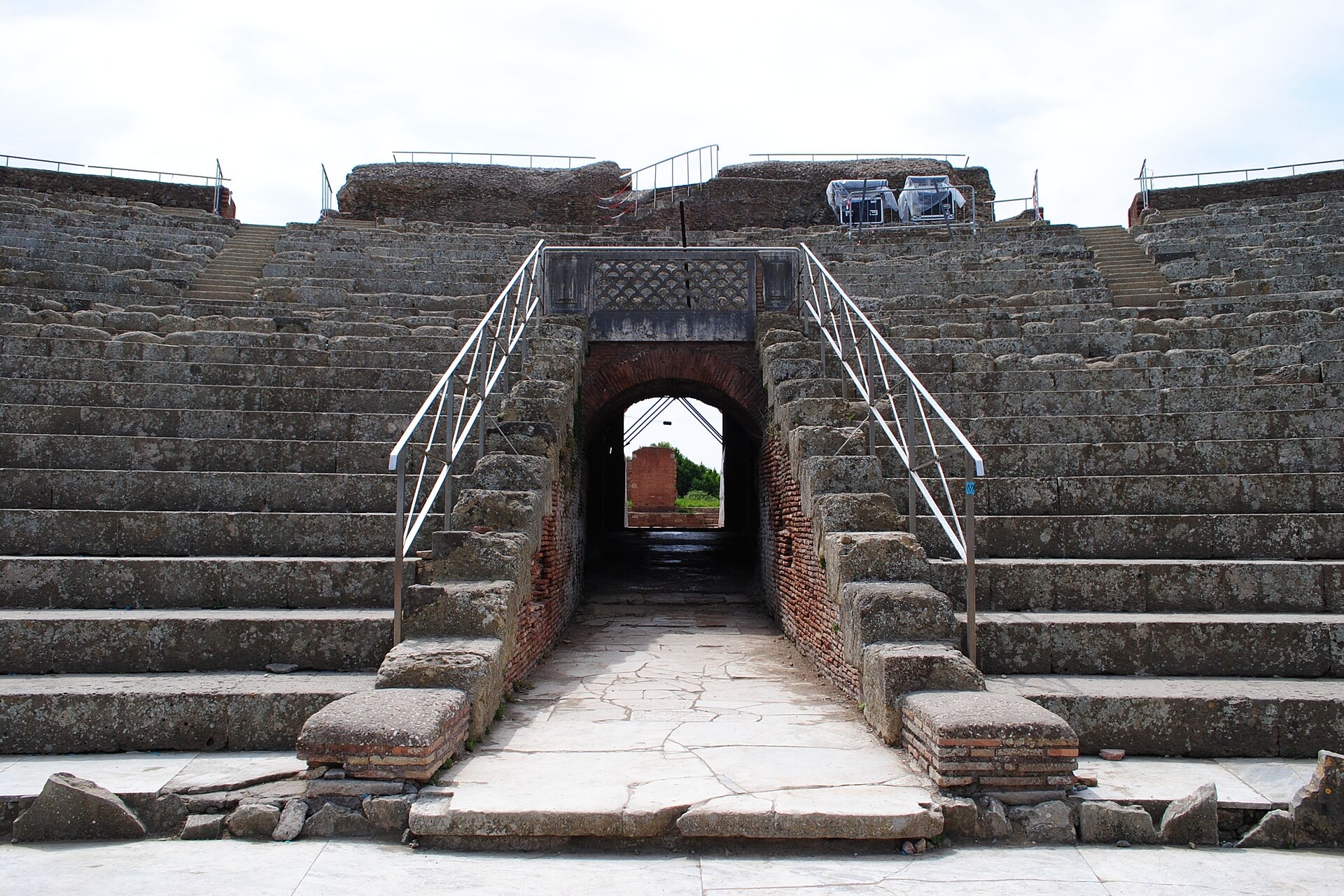
<!-- attraction:experience --> The theatre sits roughly halfway along the main excavated zone, between the Tiber gate entrance and the forum area. You approach it along the Decumanus Maximus, the ancient main street paved with large basalt blocks, then turn south into the theatre square. The seating cavea is visible immediately, a half-circle of stone benches rising in tiers. The original capacity was around 3,000 to 4,000 spectators, expanded over centuries. Three brick corridor arches survive at ground level behind the seating, part of the access system. The stage building is fragmentary, just the lower courses of the scaenae frons remain, but enough to read the layout. Mosaics of theatrical masks decorate the square behind the stage, belonging to the guild offices that funded performances. The theatre is roped off, so you view it from the perimeter and the upper seating rows rather than walking onto the stage or orchestra floor. What is memorable is the scale and the quiet.
How long it takes and when to visit
<!-- attraction:timing --> Budget 20 to 30 minutes at the theatre itself if you walk the perimeter, sit in the upper rows and photograph the masks. The larger question is how long you spend in the park. The archaeological park website describes Ostia Antica as one of the best-preserved Roman cities in the world, and the excavated area reflects that ambition. A selective walk covering the theatre, forum, baths and main apartment blocks takes three hours. A thorough visit including the museum and outer zones takes five to six hours. Guided half-day tours typically allocate three to four hours total, including transport to and from central Rome, which means two to two and a half hours on site at a fixed pace. Summer heat is the larger constraint: the site offers minimal shade, and the theatre stone benches become uncomfortably hot by mid-afternoon. Morning starts are cooler but mean sharing the route with morning tour groups.
How to get there from central Rome
<!-- attraction:access --> Ostia Antica lies roughly 25 kilometers southwest of central Rome. The independent option is the regional train from Roma Porta San Paolo station, which connects directly to Piramide Metro station on line B. The journey takes approximately 25 to 30 minutes to Ostia Antica station, and the park entrance is a 5-minute walk from the platform. Trains run regularly throughout the day, and a standard Rome public transport ticket covers the trip if it falls within the fare zone, but verify current zoning and ticket rules on the Trenitalia regional site before you travel. This route gives you control over departure and return times and costs a fraction of a guided tourGuided tourA visita guidata is a visit led by a licensed guide. In Rome the licence matters: only authorised guides may lead groups inside the Vatican Museums and the Colosseum, and some restricted areas open only with one., but it requires navigating ticket machines, checking the train direction and walking the final stretch in open air with no shade. A guided half-day tour solves all of that by including coach or minibus pickup from a central Rome meeting point, direct delivery to the park entrance and return transport, eliminating the ticket, transfer and wayfinding steps. The trade is higher cost, fixed departure time and a group itinerary that may rush or skip sections you wanted to linger over.
What to know before you visit the theatre and park
<!-- attraction:practical --> The park is almost entirely outdoors, exposed to full sun in summer and wind in winter. Bring a hat, sunscreen and more water than you think you need. The site surface is a mix of ancient paving stones, gravel paths and uneven ground, so wear ankle-supporting shoes with grip, not sandals or fashion sneakers. The park sprawls across dozens of hectares with limited seating and almost no cafes inside the excavated area, so plan rest stops and pack snacks if you are walking independently. The official Ostia Antica website directs ticket purchases to the CoopCulture platform, but it does not list exact admission prices or opening hours in the English-language source material supplied here, so confirm those details on ostiaantica.cultura.gov.it before you book. Photography is generally permitted in the open-air zones, but flash and tripods may be restricted. Accessibility is partial: the main paths are flat, but many secondary areas involve steps, raised thresholds or rough surfaces that block wheelchairs. The mistake most visitors make is underestimating the walking distance and arriving without a site map or clear priority list, then wandering randomly and missing key areas or running out of time and energy before reaching the theatre and forum.
Who the Ostia Antica theatre suits
<!-- attraction:fit --> First-time visitors to Rome should see the Colosseum, Forum, Pantheon and Vatican before spending half a day here, unless they have a week or more and a strong interest in Roman urbanism. Families with children under eight will find the scale exhausting and the monument repetition tedious, though older children studying Roman history engage well with the street grid and apartment layouts. Couples gain a quiet alternative to the crowds in central Rome, especially if they enjoy walking and photography in open landscapes. Repeat visitors with three or more previous Rome trips will value Ostia Antica highly, as it shows aspects of Roman life that the monumental core does not. Rain makes the visit miserable: the stones turn slippery, the open paths offer no cover and the theatre loses all photographic appeal under flat grey light. If rain is forecast, reschedule or choose the Borghese Gallery, Capitoline MuseumsMusei CapitoliniThe Musei Capitolini are the civic museums on the Capitoline Hill, housed in the Palazzo dei Conservatori and the Palazzo Nuovo on Michelangelo's square. They hold the Capitoline She-wolf and the bronze Marcus Aurelius. or a sheltered basilica instead.
Official sources
- https://ostiaantica.cultura.gov.it/en/
- https://ostiaantica.cultura.gov.it/en/visit/
Best tours and tickets
Curated selection. We may earn a commission if you book, at no extra cost to you.

Ostia Antica Semi Private Tour from Rome

Tour of St Peter's Basilica with Dome Climb and Grottoes
Frequently asked questions
Can you visit the Ostia Antica theatre independently without a tour?
How long should I spend at the Ostia Antica theatre and archaeological park?
Is the Ostia Antica theatre better than the Theatre of Marcellus in Rome?
What is the best way to reach Ostia Antica from central Rome?
Can you sit in the Ostia Antica theatre seating?
Is Ostia Antica worth it if I only have three days in Rome?
Related guides
Rome Museum News: What Actually Changed for Visitors This Autumn
The freshest Rome heritage news is thin this week: two art fairs in London and Venice, and what they mean for museum-goers planning a Rome trip.
Read more →Rome Museums in Late 2026: What Actually Changes for Bookings and Timed Entry
What late 2026 changes mean for Rome museum bookings, timed slots and archaeological site visits, with official pages to confirm before you travel.
Read more →Rome Museums in 2026: New Rules, Closures and What to Book Before You Go
What changed at Rome's museums, archaeological sites and Vatican collections in 2026, plus what to reserve and which official pages to check.
Read more →Rome Museums This Week: New Tiepolo Prints in Turin and What Else Changes for October
New Tiepolo print show in Turin, De Sica documentary on Sky Arte and what Rome visitors should book ahead this October.
Read more →Rome Museums in October 2026: What Is Actually Worth Booking This Month
October 2026 Rome museum planning: what the latest Italian art news changes for your trip, plus where reservations still matter and what to skip.
Read more →Rome's First Media Art Museum Opens in a Former Cinema
Rome's MAM Media Art Museum opens 9 October 2026 in a former cinema, billed as the first museum entirely dedicated to media art in the city.
Read more →All prices and times on this page are ESTIMATES and change often. They are a starting point from an independent editor, never official or guaranteed figures. Always check the final price and the opening hours with the official venue or operator before you book or travel.