Caravaggio's Judith: Barberini as the calmer Caravaggio
Open with the answer
<!-- attraction:answer -->
Palazzo Barberini displays CaravaggioCaravaggioCaravaggio, born Michelangelo Merisi in Milan in 1571 and dead at Porto Ercole in 1610, is the painter of dramatic light whose Roman years left works in the Borghese, the Doria Pamphilj, Palazzo Barberini and three ch...'s Judith Beheading Holofernes without the timed-entry choreography that governs the Borghese GalleryGalleria BorgheseThe Galleria Borghese is the state museum in the Borghese villa holding Bernini's sculptures and the Caravaggio paintings collected by Cardinal Scipione Borghese. Entry is by reserved two-hour slot only.. You walk in when the museum is open, see the painting, and leave. The Borghese demands a reserved two-hour window booked days or weeks ahead. If spontaneity or a flexible schedule matters, Barberini wins.
Is it worth it?
<!-- attraction:worth -->
The case for Barberini is logistical and compositional. You skip the reservation lottery that dominates Borghese planning, and you see one of Caravaggio's most violent canvases in a building designed by three architects whose names define Baroque RomeBaroqueThe Baroque is the art of seventeenth-century Rome: theatrical, emotional and built for the Counter-Reformation papacy. Bernini, Borromini and Caravaggio are its Roman names.. Carlo Maderno, Gian Lorenzo BerniniGian Lorenzo BerniniGian Lorenzo Bernini (1598 to 1680) was the sculptor and architect who shaped Baroque Rome: the Borghese sculpture groups, the colonnade of St Peter's Square and the fountains of Piazza Navona. and Francesco BorrominiFrancesco BorrominiFrancesco Borromini (1599 to 1667) was Bernini's rival and the most inventive architect of the Roman Baroque. At Palazzo Barberini the oval helicoidal staircase is attributed to him. each left staircases, façades and spatial ideas in the same palazzo, according to the Barberini Corsini Galleries. The painting itself, Judith sawing through Holofernes' neck while her maid waits with a bag, is forensically detailed and theatrically lit. The blood arcs, the hand grips the hair, the faces freeze mid-action.
The case against is thinner context. The Borghese Gallery arranges its Caravaggios in a denser sequence, and the forced two-hour limit pushes you through faster than you might want. Barberini spreads its collection across a much larger floor plan, so the walk between highlights is longer. First-time visitors chasing only Caravaggio may find the Borghese's clustering more efficient, if they can secure the slot. Repeat visitors who already waited in that queue prefer Barberini's open door.
What you actually see and do
<!-- attraction:experience -->
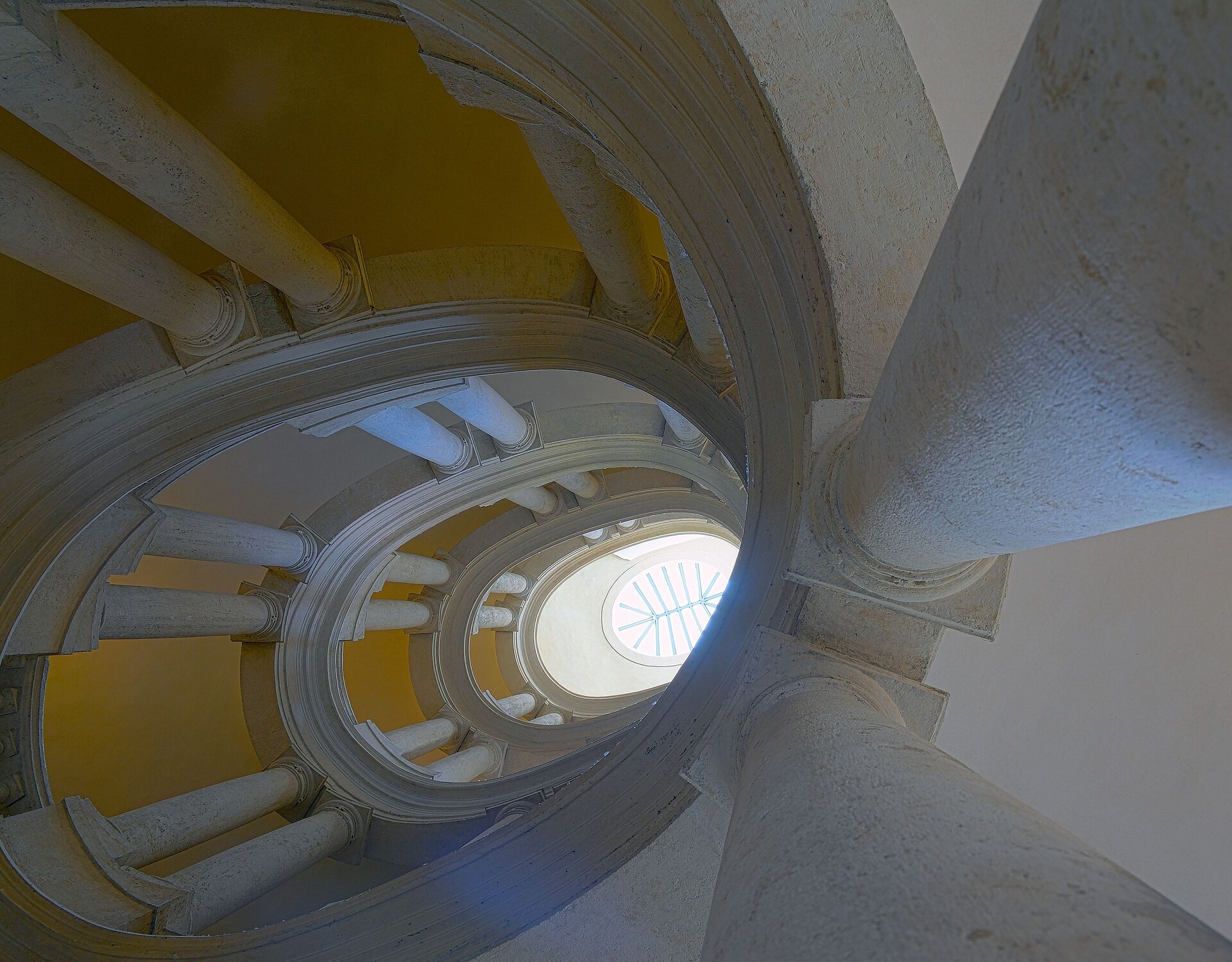
You enter Palazzo Barberini from via delle Quattro Fontane, according to the official site, through the portico and into the ground floor. The square-plan staircase designed by Bernini rises on one side, and you can take either route up. The other option is Borromini's probable oval helicoidal staircase, a spiral that tightens as it climbs and feels like walking inside a stone nautilus. Most visitors choose Bernini going up and Borromini coming down, which means you descend the more interesting geometry. Do it backwards.
The Caravaggio hangs in the second-floor galleries. Judith Beheading Holofernes is not a subtle painting. The old general lies on his back, blood spraying from his half-severed neck, while Judith leans her weight into the sword and pulls his head toward her by the hair. Her maid, an older woman, holds a cloth ready to wrap the trophy. The tent canvas behind them is dark red, and the light comes from the left, carving every fold and shadow. Caravaggio painted it around 1598 or 1599, before his own violence turned him into a fugitive. The same floor holds RaphaelRaphaelRaphael (1483 to 1520) painted the four Raphael Rooms in the Vatican for Julius II and his successors and is buried in the Pantheon. His Transfiguration hangs in the Vatican Pinacoteca.'s Fornarina and works by Bronzino, Lotto and Tintoretto, all in rooms decorated with 17th and 18th-century frescoes and stucco. Pietro da Cortona painted the ceiling of the gran salone, a vast illusionistic sky that opens above the entrance hall.
How long it takes and when to go
<!-- attraction:timing -->
Allow 90 minutes if Caravaggio is the main goal and you skim the surrounding collection. Add another hour if you stop for the Raphael, the two staircases and the Cortona ceiling. The palazzo contains far more than those anchors, and a complete visit examining every floor and decorative cycle can stretch past three hours. The shorter visit is not rushed, it is edited.
That silence means you cannot reliably predict which window will be calmer, and the advantage Barberini holds over the Borghese is not crowd level but admission flexibility. You do not pick a time slotTimed entry slotA fascia oraria is the entry window printed on a Rome museum ticket. It fixes when you may enter, and at some museums how long you may stay. days in advance, so you can adjust the visit to weather, fatigue or a delayed lunch without losing a non-refundable ticket. Check the current visiting conditions and any temporary closures on the official site before crossing Rome.
How to get there
<!-- attraction:access -->
Palazzo Barberini stands on via delle Quattro Fontane, near the intersection with via Barberini, in central Rome. The walk from Piazza della Repubblica takes about 12 minutes, and from the Trevi Fountain about 10 minutes on foot. Metro Line A stops at Barberini, the station named for the family and the square, and from there the palazzo entrance is a short walk uphill. Buses and trams serving the area stop nearby, but the official Barberini Corsini site does not enumerate every route. If you are coming from Termini station, the Metro connection is faster than surface transport.
The neighbourhood is dense with other targets. The Quirinal Palace, official residence of the Italian President, sits 400 metres east along via del Quirinale. The Trevi Fountain, Piazza di Spagna and the Villa Borghese park all lie within a 15-minute walk, which makes Palazzo Barberini a natural leg in a longer walk rather than an isolated destination. Taxis and ride-hailing services can drop you at the palazzo entrance, though the street is one-way and narrow. Walking from your hotel or previous stop is usually simpler than arranging a car.
What to know before you go
<!-- attraction:practical -->
Palazzo Barberini enforces standard museum security, so bags larger than a daypack will need to be checked. The official site mentions a storage facility and conservation laboratory on the premises, though visitor bag storage is routine, not specialized. Photography without flash is generally allowed, but check current policy on-site because rules change. Wear comfortable shoes, the floors are marble and stone, and the palazzo unfolds across multiple levels with long galleries.
The biggest mistake visitors make is treating Barberini as a one-painting stop. The Caravaggio is the headline, but the building itself is the story, a collaboration and competition among three architects whose careers defined Roman Baroque. Maderno set the H-plan in 1625, Bernini took over in 1629 after Maderno's death, and Borromini worked under and against Bernini before they split. The staircases encode that rivalry, one square and classical, the other oval and inventive. Miss those and you have flown past the reason the palazzo still stands as a museum instead of private apartments.
Accessibility information for visitors with mobility limits should be confirmed on the Barberini Corsini official site. The building is historic, and adaptations may not cover every floor or gallery. Rain is irrelevant, the collection is entirely indoors.
Who it suits
<!-- attraction:fit -->
First-time visitors to Rome with a Caravaggio checklist should weigh the Borghese's denser Caravaggio sequence against Barberini's open-door policy. If your schedule is loose, Barberini fits better. Families with children who cannot commit to a two-hour timed window will find Barberini easier to manage, though the galleries are large and the route is not fully linear, so children who tire fast may resist the full circuit. Couples chasing Baroque architecture and painting in one stop should prioritize Barberini, because the building demonstrates what Bernini and Borromini actually built, not what guidebooks claim they represented. Repeat visitors who already endured the Borghese slot system once will appreciate Barberini's calmer entry, and the Caravaggio is no less powerful here than it would be across town. Rain-day visitors looking for an indoor refuge longer than an hour but not an all-day commitment will find the palazzo fits that window better than smaller house museums or single-chapel stops.
Official sources
- https://barberinicorsini.org/en/collections/
- https://barberinicorsini.org/en/palazzo-barberini/
Best tours and tickets
Curated selection. We may earn a commission if you book, at no extra cost to you.

Exclusive Borghese Gallery Tour with Skip-the-Line Access

Tour of St Peter's Basilica with Dome Climb and Grottoes
Frequently asked questions
Do you need to book a timed entry slot for Palazzo Barberini?
Where is Caravaggio's Judith Beheading Holofernes displayed in Rome?
How long does a visit to Palazzo Barberini take?
Which architects designed Palazzo Barberini?
Can you see multiple Caravaggio paintings at Palazzo Barberini?
Is Palazzo Barberini easier to visit than the Borghese Gallery?
Related guides
Rome Museums in Late 2026: What Actually Changes for Bookings and Timed Entry
What late 2026 changes mean for Rome museum bookings, timed slots and archaeological site visits, with official pages to confirm before you travel.
Read more →Rome Museums in 2026: New Rules, Closures and What to Book Before You Go
What changed at Rome's museums, archaeological sites and Vatican collections in 2026, plus what to reserve and which official pages to check.
Read more →Rome Museum News: Vatican Museums, Colosseum and New Heritage Rules for Autumn 2026
New heritage rules, exhibitions and ticketing changes in Rome museums. What travelers need to book now for autumn 2026.
Read more →Raphael's Lady with a Unicorn Leaves the Borghese Gallery for Vimercate
Raphael's Lady with a Unicorn leaves the Borghese Gallery for a free show at MUST Vimercate, 29 October to 11 December 2026. Plan the Rome side.
Read more →Rome Museums: What October 2026 Travelers Actually Need to Check Before Booking
Independent guide to Rome museums and heritage. Verify tickets, reservations and closures on official sites before your October 2026 trip.
Read more →Rome Museums in October: What Changes for Visitors, From Closures to New Access Rules
October shifts behind the scenes at Rome's museums and sites. Check official pages for closures, timed entry and reservation rules before you book.
Read more →All prices and times on this page are ESTIMATES and change often. They are a starting point from an independent editor, never official or guaranteed figures. Always check the final price and the opening hours with the official venue or operator before you book or travel.